Agentic Reasoning with Microsoft Agent Framework (MAF)
In the first article I showed you how to run MAF fully offline, using Docker Model Runner (DMR) as the intelligence engine.
In the second article, we added memory, persistence, so the agent could recall previous turns.
In this third step of the series, the agent finally reasons.
This is where MAF starts feeling alive.
From Conversations to Reasoning Loops
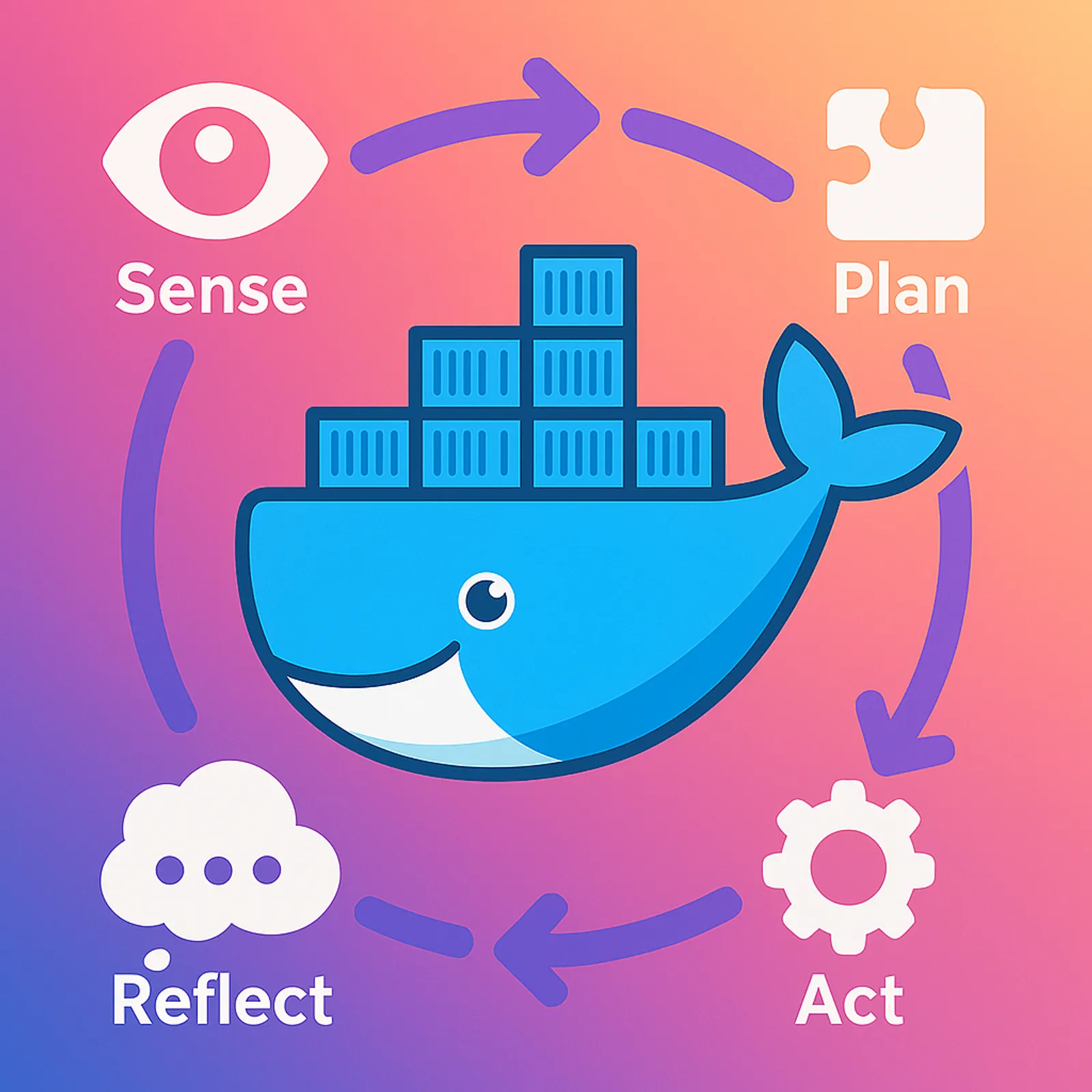
The goal of this lab is simple: implement the Sense → Plan → Act → Reflect (SPAR) cycle, the fundamental reasoning loop behind every agentic system, as I explained in recent article AI Agents in a Nutshell.
(Side note: I recently finished reading “Agentic Artificial Intelligence: Harnessing AI Agents to Reinvent Business, Work and Life”, and I strongly recommend it to anyone exploring agentic AI engineering.)
Using Docker Model Runner as the LLM backend and Model Context Protocol (MCP) with tools like DuckDuckGo and Fetch Reference, we can build an autonomous agent capable of researching topics, deciding which tools to call, acting, and summarizing what it found. All local. No API keys. No clouds. No OpenAI. As Mitko Vasilev’s mantra sais:
Make sure you own your AI. AI in the cloud is not aligned with you; it’s aligned with the company that owns it.
Running the Lab
This demo is built in .NET, though the Python version follows (will follow) the same structure. The full source lives in the Microsoft Agent Framework Playground.
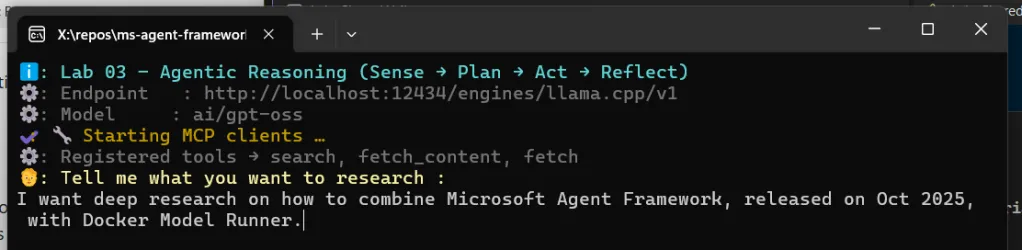
When executed, the agent connects to two MCP tools (duckduckgo, fetch), merges them into a single toolset, and runs a reasoning loop:
-
Sense – interpret the user query and detect intent.
-
Plan – decide which tools to call.
-
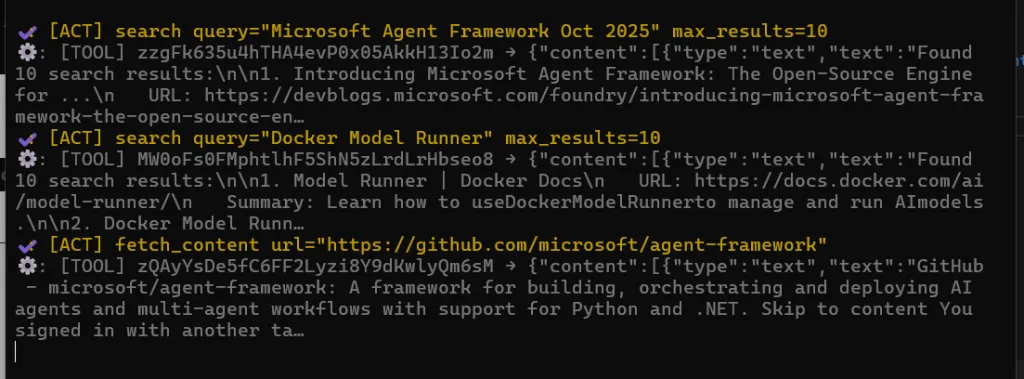
Act – execute those tools via MCP.
-
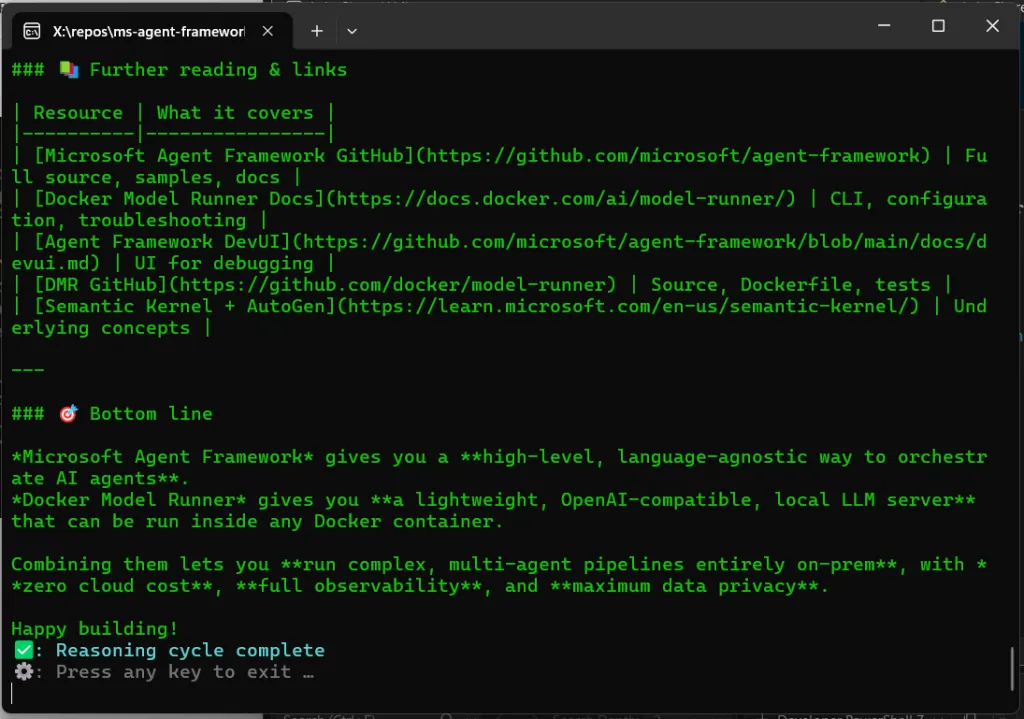
Reflect – summarize findings and verify completeness.
The Echo helper narrates the process in real time, showing reasoning, tool calls, and results as color-coded console output.
Sense
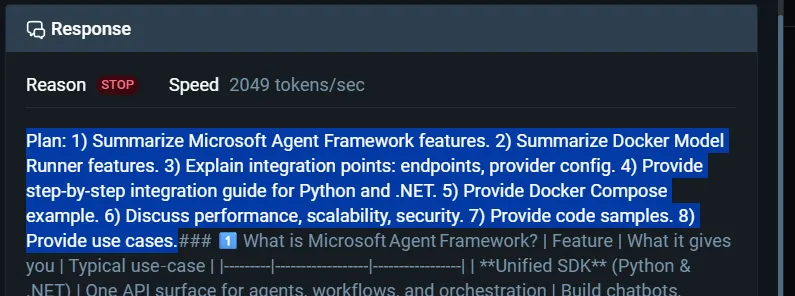
Plan
Act
Reflect
The Code
The heart of the demo is a ~100 line console application, much simpler than Lab 02, but conceptually deeper… It configures the local LLM, connects to MCP tools, and executes the full reasoning loop.
Echo.Info("Lab 03 – Agentic Reasoning (Sense → Plan → Act → Reflect)");

// Local LLM via Docker Model Runner
var baseUrl = "http://localhost:12434/engines/llama.cpp/v1";
var modelId = "ai/gpt-oss";
var client = new OpenAIClient(
    new ApiKeyCredential("none"),
    new OpenAIClientOptions { Endpoint = new Uri(baseUrl) });
var chatClient = client.GetChatClient(modelId);

// Connect MCP tools (DuckDuckGo + Fetch)
await using var duck = await McpClient.CreateAsync(new StdioClientTransport(...));
await using var fetch = await McpClient.CreateAsync(new StdioClientTransport(...));
var tools = (await duck.EnumerateToolsAsync().ToListAsync())
    .Concat(await fetch.EnumerateToolsAsync().ToListAsync())
    .Cast<AITool>().ToArray();

// Build the reasoning agent
var instructions = """
You are a self-sufficient research agent.
Sense → Plan → Act → Reflect.
Always show progress before your final answer.
""";

var agent = chatClient.CreateAIAgent(instructions, "ResearchAgent", tools);
await Echo.StreamAgentAsync(agent.RunStreamingAsync("Is it possible to combine MAF with DMR in .NET?"));
The agent analyzes the query, selects the right tools, gathers information, and produces a concise, validated summary, all offline.
About the Context Window
If you followed the previous articles, you might have noticed that long reasoning runs tend to stall or truncate early. That’s because Docker Model Runner enforces a default context window of 4096 tokens, which is often too small for multi-tool workflows. There’s no configuration flag or CLI parameter to change it, which caused many failed runs during testing.
To solve this, I wrote a small PowerShell utility that expands the DMR context size by re-initializing the model with a larger max_tokens setting. It’s explained step-by-step in this other article.

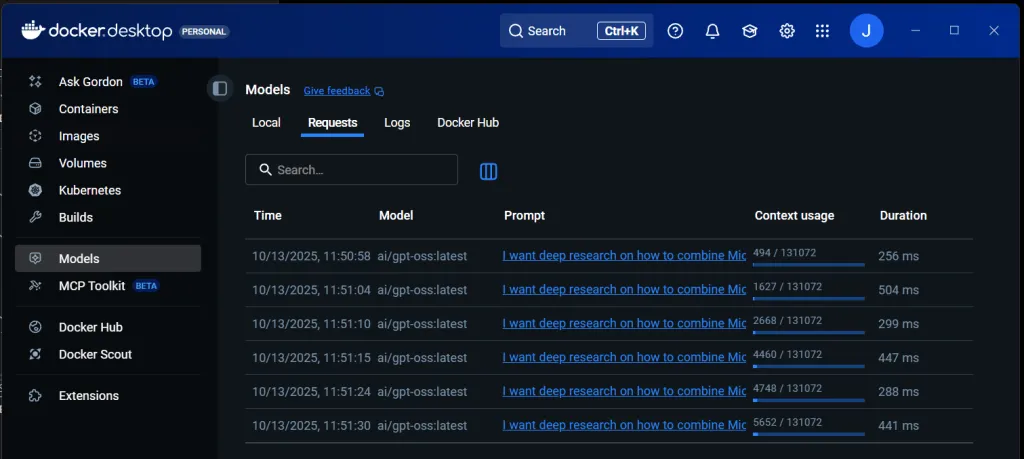
In this case I’ve set this model, ai/gpt-oss:latest, to use 128k tokens (128*1024=131072 tokens)
Results
Once the model’s context window was expanded, the reasoning loop ran flawlessly. MAF handled multi-step tool invocation, parallel streaming, and reflection without a single token overflow. and DMR gave us huge Intelligence power at an awesome speed
This confirms that MAF + DMR can serve as a fully local, reproducible agentic environment, ideal for private R&D or offline deployments like Sentra Brain, my side proyect, which has been paused due to my recent agentic frameworks research.