AI Agents in a Nutshell
AI agents are one of the most exciting evolutions in artificial intelligence. Instead of just responding to prompts, agents loop between reasoning, using tools, and reflecting until they achieve their goal.
What is an AI Agent?
A simple definition:
An AI agent is a program that combines reasoning with a language model (LLM or LRM — large or small) and external tools, repeating this cycle until it reaches its objective.
This makes agents active problem-solvers, not just passive chatbots. Unlike conversational AI systems (e.g. ChatGPT), which mainly rely on session context or vendor-managed memory, agents can be designed with their own memory, tools, and persistence.
The Core Loop of an AI Agent
At the heart of every agent is a decision loop:
-
Input – capture a user query or event.
-
Instructions – apply rules, policies, or constraints.
-
Memory – recall preferences or prior knowledge.
-
Language Model – decide whether to reason, act, or respond.
-
Tools & Knowledge – access APIs, databases, or retrieval systems (RAG).
-
Reasoning – analyze results, refine plans, reflect on progress.
-
Output – produce a response or trigger an effect.
-
Storage – save the session for continuity.
This cycle continues until the agent achieves its goal.
The SPAR Framework: Sense, Plan, Act, Reflect
A useful way to understand agents is through SPAR:
-
Sense → gather input from users, environments, and memory.
-
Plan → reason with the LLM and decide next steps.
-
Act → execute actions via tools or knowledge sources.
-
Reflect → evaluate outcomes, adjust, and store results.
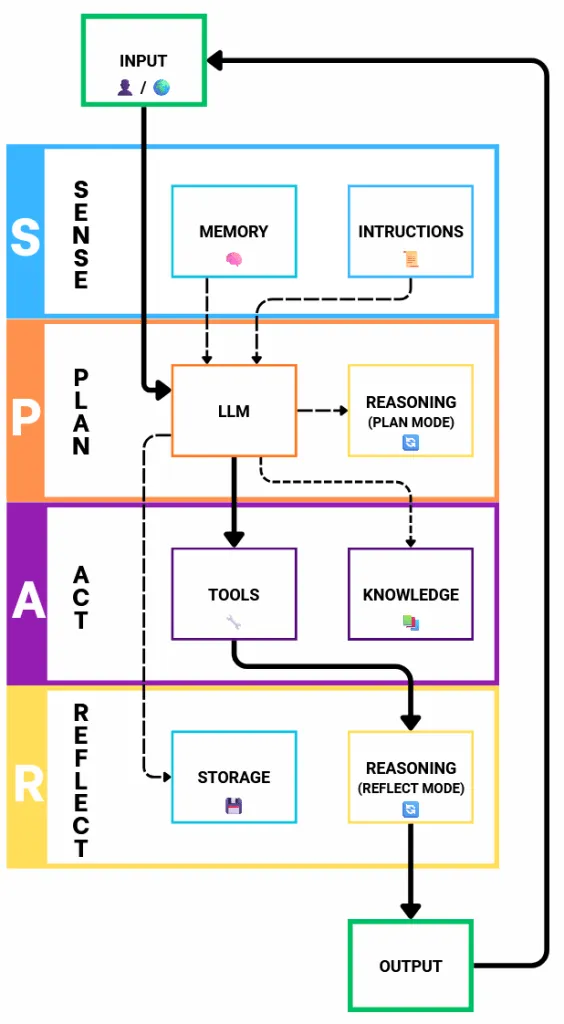
SPAR provides a human-friendly mental model for designing, explaining, and improving AI agents.
Why AI Agents Matter
-
From static to dynamic – They don’t just answer, they act and adapt.
-
Goal-oriented – They keep working until a result is achieved.
-
Closer to human workflows – The loop of sensing, planning, acting, and reflecting mirrors how people tackle problems.
What’s Next
Building real-world AI agents requires more than just loops and reasoning. Future articles will cover essential topics such as:
-
Guardrails – ensuring safe, predictable behavior.
-
Security and authorization – controlling access to data stores and APIs.
-
Conflict resolution – handling competing or conflicting goals.
In a Nutshell
AI agents sense, plan, act, and reflect. They move beyond text generation into autonomous collaboration, bridging models, whether language models (LLMs), reasoning models (LRMs), large or small, with tools, memory, and knowledge.
The journey is just beginning. The next steps are about making agents not only more powerful, but also safe, secure, and reliable.