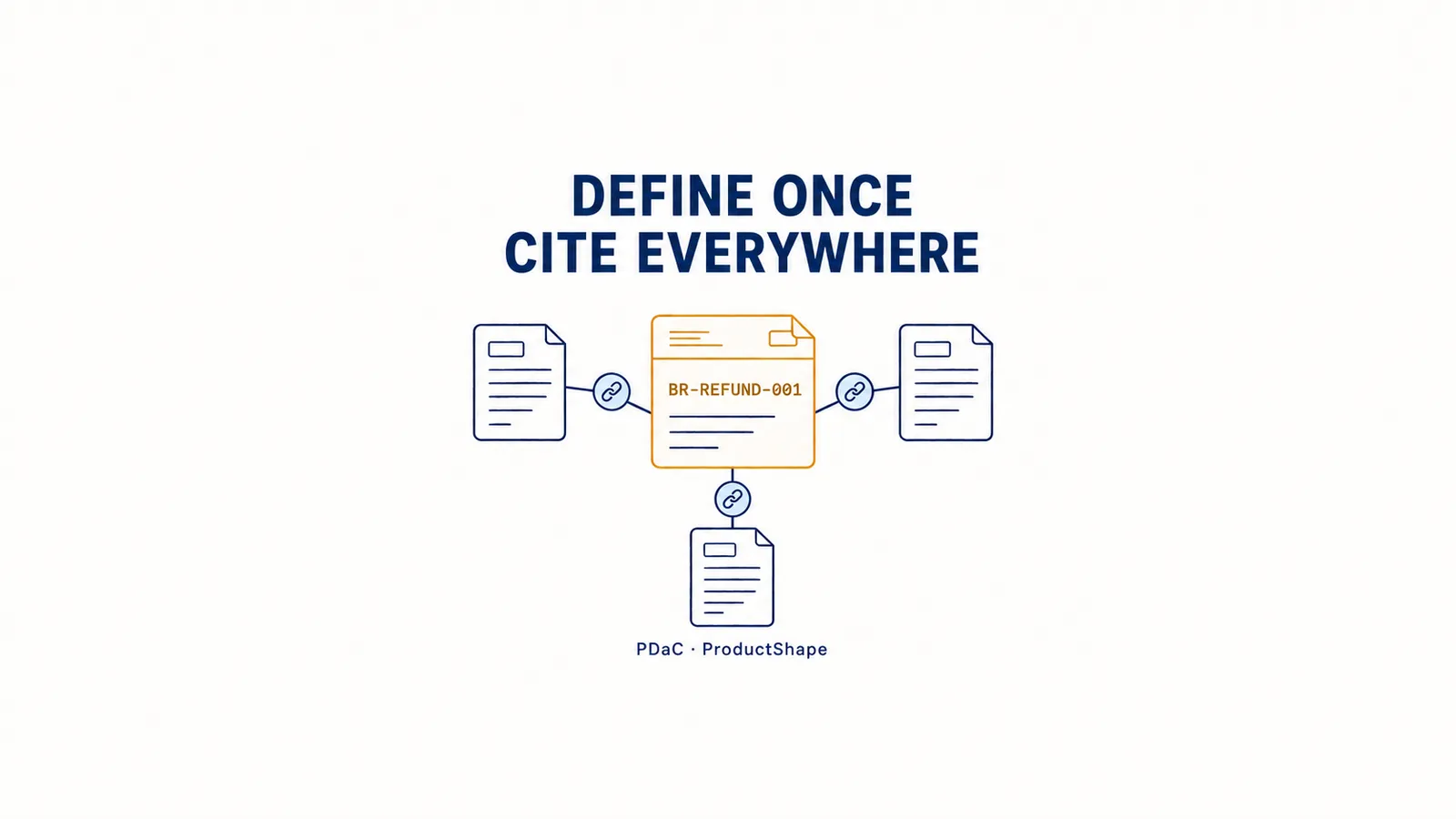
Define Once, Cite Everywhere
Run this on any repo that has been doing spec-driven development for a few weeks:
grep -rn -i "refund" openspec/specsSwap “refund” for any business rule you own. Here is what it returned on a repo of mine:
billing/spec.md:4:  Refunds are issued for purchases made in the last 30 days.
checkout/spec.md:4: Customers can request a refund within 30 days of delivery.
support/spec.md:4:  If the order is less than a month old, offer a refund.
Same rule. Three specs. Three wordings, and two different meanings. Thirty days from purchase is not thirty days from delivery. Nobody decided that fork. Nobody reviewed it. A coding agent paraphrased it into existence, because every new spec re-explains the product from scratch, and paraphrase is drift.
Be honest about who reads these files. Humans read them once, while defining the goals, and then move on to the code. From that point on, specs are words that only a coding agent reads, on every invocation, as truth. Which means a fork like the one above doesn’t get caught in review. It gets implemented.
We solved this problem in code decades ago: don’t repeat yourself. Extract the function, call it. Specs never got that memo: they still copy-paste the product on every increment, and now LLMs do the copying at machine speed, with small mutations each time.
The fix is the same fix
Define the rule once, canonically. Then specs cite it instead of restating it.
npm install -g @prodshape/cli@0.12.0The rule becomes one small versioned file:
---
id: BR-REFUND-001
type: business-rule
title: Refund window
status: active
---

## Rule

Refunds are accepted within 30 days of delivery.
And each spec drops its paraphrase for a reference. One line, generated by the CLI, carrying a content digest of the rule at the moment it was cited:
## Returns
Refunds follow BR-REFUND-001. {pdac:cite id="BR-REFUND-001" digest="sha256:9f0c…"}
$ prodshape citations verify
current BR-REFUND-001 openspec/specs/billing/spec.md:4
current BR-REFUND-001 openspec/specs/checkout/spec.md:4
current BR-REFUND-001 openspec/specs/support/spec.md:4The payoff
The rule changes through review, through your normal flow, and 30 days becomes 14. You don’t grep the repo wondering which documents still say the old thing:
$ prodshape citations verify
stale  BR-REFUND-001  openspec/specs/billing/spec.md:4
stale  BR-REFUND-001  openspec/specs/checkout/spec.md:4
stale  BR-REFUND-001  openspec/specs/support/spec.md:4
warning PRODUCT061: Citation of 'BR-REFUND-001' is stale: canonical content
changed since the citation was recorded
Every spec that cites the rule, flagged, with file and line. Put that command in CI and stale product knowledge stops being invisible. And an agent reading a spec follows the citation to the current rule instead of trusting last month’s paraphrase.
Three things happen at once:
- Specs get shorter. They reference the product instead of re-explaining it on every increment.
- Forks become impossible. There is nothing to fork because the rule has one home.
- Drift becomes detectable. A digest either matches or it doesn’t. No judgment calls, no repo-wide review.
Here is the full 30-second script: the fork, the fix, the catch. Four files, no init, no git required. Everything below is real output from @prodshape/cli@0.12.0:
Where this sits
This is the core idea of Product Definition as Code: keep one versioned product model (actors, journeys, use cases, business rules, requirements) that specs and agents cite instead of re-derive. It sits upstream of whatever SDD tool you use. The demo above is OpenSpec-shaped, but the citation contract doesn’t care what generates or consumes your specs: Spec Kit, Kiro, plain markdown, all the same.
Try the grep
Run it on your own specs. Pick your most-repeated business rule and count the wordings. If you find a fork, I want to hear about it. And if you want citations running on your repo, I’ll help you set it up. It takes about ten minutes, maybe less: reach out on LinkedIn.